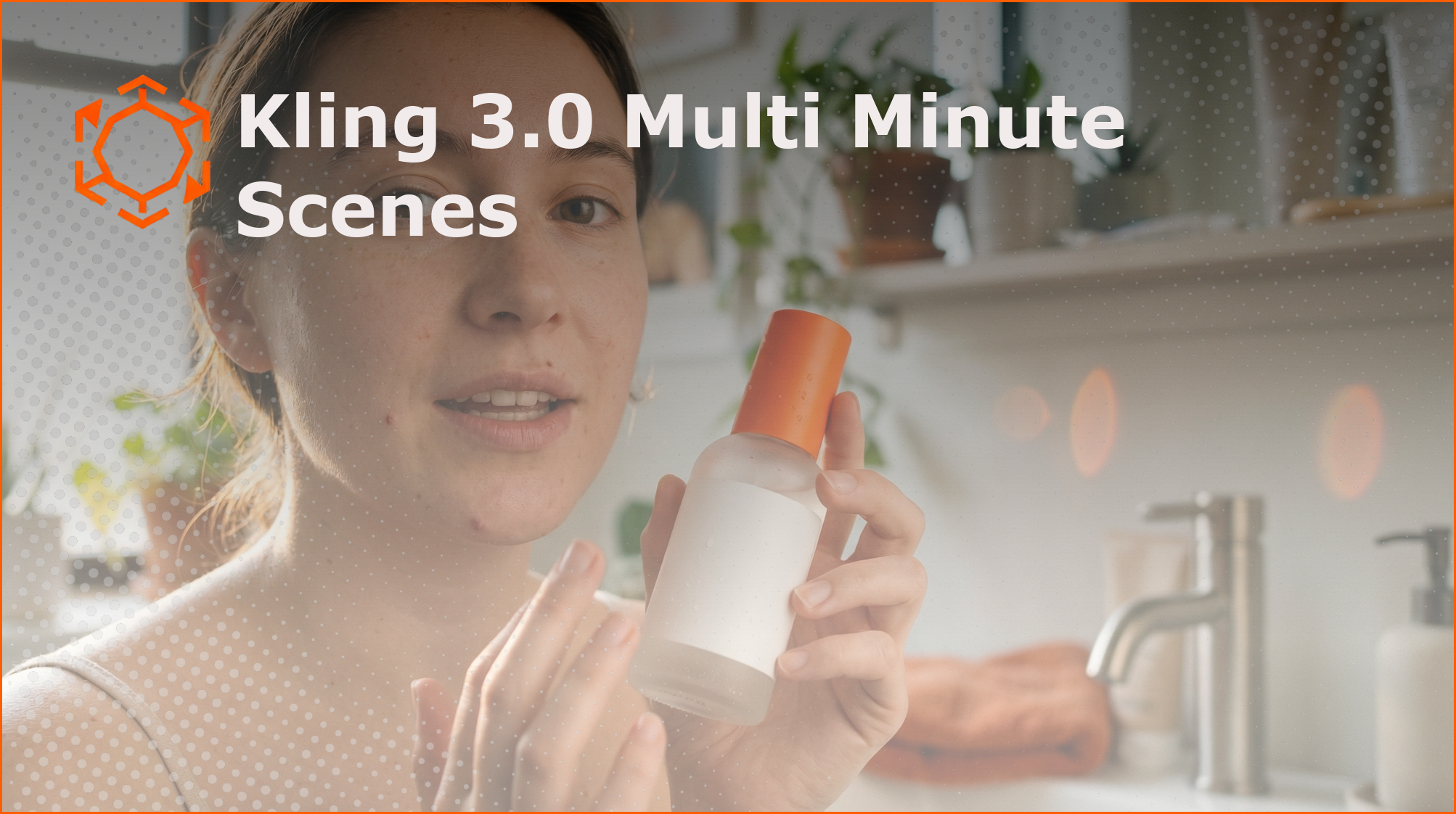
Can Kling 3.0 Really Produce UGC-Style, Dialogue-Driven Skincare Ads That Don’t Scream “AI”?
TL;DR:
Yes, sometimes. But if you rely on Kling 3.0’s native voice straight out of the render, you’ll keep tripping the “AI cadence” wire. The fastest path to believable UGC-style skincare ads is: design the shots so skin doesn’t look plastic, render clean dialogue video, swap in a better voice (and optionally re-lip-sync), upscale/sharpen for texture, then run a ruthless QC checklist. If you want this to scale beyond a single hero clip, you need automation: script variants → voice variants → render queue → upscales → naming + exports. That’s exactly the kind of assembly line n8n is good at.
I’ll be blunt: the problem isn’t “can it generate a pretty face.” The real problem is whether it can hit the weird, specific UGC tells that make TikTok/Reels ads convert: believable talking, micro-expressions, throwaway hand gestures, continuity across cuts, and that one money shot where the product is readable and the focus pull feels like an actual phone camera trying its best.
The actual question you’re asking (even if you don’t say it out loud)
“Can Kling 3.0 make UGC-style skincare ads?” is the headline. The practical question is nastier: can it do it consistently—day after day, variant after variant—without you babysitting every render like it’s a fragile sourdough starter?
For paid social, “close” isn’t close. A clip can be 95% believable and still tank because the last 5% is where trust lives: cadence, skin texture, and tiny timing mismatches between what the mouth does and what the voice implies.
The five UGC “tells” that decide whether people scroll past you
If you’re trying to pass as natural influencer content (not a glossy commercial), you’re judged on details that sound petty… until you’ve bought media and watched CPMs climb.
- Speech realism: lip-sync accuracy plus believable phrasing, breath, and timing. People don’t talk like a GPS.
- Micro-expressions: the little half-smiles, eyebrow flicks, and “wait, what?” pauses that read as thought rather than playback.
- Hand behavior: casual gestures that don’t look like a marionette practicing sign language.
- Continuity across shots: same person, same vibe, consistent lighting, consistent hair/wardrobe, no mysterious teleporting earrings.
- Product-focus moment: readable label, plausible shallow depth of field, and a focus pull that feels like a real lens (or phone) hunting briefly then locking.
The annoying part is these tells are coupled: if you push for extreme close-ups to show “glowy skin,” you also expose the very artifact that gives the game away—synthetic skin texture.
Where Kling 3.0 tends to win—and where it faceplants
In my experience watching teams play with these models, Kling 3.0 looks strongest when you treat it like a director’s assistant: get fast drafts, choose a workable take, then do finishing work outside the model. That’s not a knock. That’s just… reality in 2026.
The good news
You can get a very believable “creator on a phone” look: imperfect framing, soft indoor light, casual pacing. And if the shot design is smart (more on that in a sec), you’ll get something people accept as UGC at a glance.
The usual giveaways
Two things still tend to light up the “AI detector” in a viewer’s brain: (1) voice cadence that lands like a corporate training video, and (2) skin that’s a little too… laminated. Like a plastic screen protector over a human.
That second one matters extra for skincare. You’re literally selling skin. If the skin looks like porcelain, you’ve stepped on the rake.
Design around the uncanny valley: shot direction that forgives the model
This is the part marketers skip because it sounds like “filmmaking.” But UGC is filmmaking. Just cheaper and messier.
- Avoid extreme macro close-ups on cheeks/forehead under hard key lights. That’s where plasticity shows up first.
- Use “mid-close” framing (head + shoulders) for dialogue, then cut to b‑roll hands for the product moment. Let hands do the selling.
- Prompt for real-world imperfections: slight under-eye texture, faint freckles, minor shine, a tiny blemish. Not a lot. Just enough to feel lived-in.
- Keep background believable: bathroom, bedroom, kitchen window light. “Creator apartment energy,” not studio cyclorama.
- Product readability is a separate problem—treat it as a dedicated shot with its own prompt and camera instructions (rack focus, 50–70mm equivalent feel, slight focus hunt).
Also: don’t ask the model to do too much in one continuous clip. Humans can do that; models get wobbly. Let it breathe. Short takes. Cut aggressively. Nobody complains—this is TikTok, not Sundance.
The quickest quality bump: replace the voice (and don’t be precious about it)
If you do one thing this week, do this: stop treating the native voice track as sacred. Swap it.
Why it works: viewers tolerate a tiny bit of visual weirdness if the voice sounds human and the timing feels conversational. But a synthetic cadence—overly even emphasis, dead-flat enthusiasm, “script read” rhythm—makes everything else feel fake, even if the pixels are gorgeous.
Use a voice stack that you can control: multiple takes, light stumbles, intentional breaths, and a little speed variation. ElevenLabs is a common pick because it’s fast and configurable, but the brand doesn’t matter as much as the result: does it sound like a person who’s slightly in a hurry? Perfect is suspicious.
A pragmatic voice recipe for “creator energy”
- Write like you talk: contractions, short clauses, occasional repetition. “Okay, so—quick update…” works. “Introducing our revolutionary formula…” does not.
- Leave in one tiny self-correction. Not a whole blooper reel. Just a “I’ve been using this for… like, two weeks.”
- Aim for 130–160 wpm, but vary by sentence. Real people speed up on the hook and slow down on specifics.
- Record two versions: “excited friend” and “tired-but-honest.” Sometimes the tired one wins. Humans are weird.
Upscaling isn’t a magic wand, but it helps (especially for skin and packaging)
Upscaling can’t invent authenticity, but it can reduce the “cheap compression” vibe that makes people squint. For skincare ads, a mild upscale plus subtle sharpening can bring back pore-level texture and make label text less mushy. Just don’t crank it so hard you get crunchy halos. Been there, regretted that.
If you’re making 9:16 for TikTok/IG, remember you’re still at the mercy of platform recompression. So the goal isn’t “8K cinema.” It’s “survives upload without turning into soup.”
A workflow that ships variants fast (without hiring creators)
Here’s the assembly line I’d use if my job was “produce 30 UGC-style skincare ad variants by Friday afternoon.” Not because it’s pretty—because it’s dependable.
Step 1: Generate scripts like a performance marketer, not a novelist
Make 10–20 scripts that differ in hook + mechanism + proof + CTA. Keep them tight. 12–20 seconds is plenty. And for the love of CPMs, don’t cram six benefits into one breath.
- Hook angles: “I didn’t think this would work,” “If you’re dealing with redness…,” “My makeup kept separating until…,” “I tried the expensive stuff—then found this.”
- Proof style: routine context (“night routine”), sensory detail (“absorbs fast, no sticky”), and one measurable claim (if compliant).
Step 2: Render visuals with guardrails
Don’t chase a single “perfect” take. Generate a small batch per script and pick the least-wrong one. That’s the secret nobody wants to admit: creative production is mostly choosing the least-wrong thing quickly.
- Dialogue shot prompt: casual indoor light, handheld phone feel, slight camera wobble, natural blink rate, minor skin texture, realistic hair flyaways.
- Product shot prompt: hands in frame, readable label, rack focus from face to product, brief focus hunt, shallow DOF but not absurdly creamy.
Step 3: Replace voice, then (optionally) re-lip-sync
This is where a lot of teams get tangled. Keep it simple: generate the voice audio from your preferred TTS/voice model, then apply lip sync to match. If the visuals already include speech, you might instead render without relying on that audio at all and treat the whole voice track as a replaceable layer.
Step 4: Upscale + light cleanup
Run an upscale, then do tiny color/contrast tweaks so it doesn’t feel “rendered.” UGC is usually slightly flat, slightly warm, and a bit imperfect. Too much cinematic grade and you’re back in commercial land.
Step 5: QC checklist (the part that saves your brand)
Watch with the sound off. Then watch audio-only. Then watch normally. If it survives all three, it’s usually fine.
- Mouth shapes: do consonants land? (“M,” “B,” “P” are brutally revealing.)
- Blink + gaze: do they look at the “camera” when making the key claim?
- Skin: does it look like skin under your target platform’s compression?
- Packaging: can you read the brand/product name for at least 12–18 frames?
- Claims: are you accidentally implying medical outcomes or before/after results you can’t substantiate? Easy mistake, expensive consequence.
Automate the boring parts with n8n (this is where teams win back their week)
If you’re doing this manually, you’ll get exactly three variants out the door, feel proud, and then quietly never do it again. The leverage is in automation: consistent inputs, consistent naming, consistent exports, repeatable QA.
In n8n, you can build a “UGC Ad Factory” pipeline that takes a product brief and outputs a folder of ad-ready MP4s plus a spreadsheet of what’s inside each one. It’s not glamorous. It is profitable.
Example n8n workflow blueprint
- Input: Airtable/Notion row (product name, 3 benefits, objections, compliance notes, desired vibe).
- Script generation: LLM node produces 10 hooks × 3 bodies × 2 CTAs, plus a “creator-ish” version and a “calm derm vibe” version.
- Voice: generate WAV/MP3 per script via your preferred TTS (and store voice settings with the asset for repeatability).
- Video render queue: call your video generation step (Kling 3.0 or a benchmark tool) with structured prompts + seeds + reference images.
- Lip sync: apply the voice to the chosen clip, or generate a lip-synced version directly if your stack supports it reliably.
- Upscale: run a worker (cloud or local) to upscale, denoise lightly, and normalize loudness.
- QC automation: basic checks (duration, resolution, audio peak, black frames). Flag for human review if anything looks off.
- Export: upload to Drive/S3, generate filenames with angle + hook + version, and write metadata back to your tracker.
This is the kind of workflow we ship at brilliantworkflows.com: production-ready n8n automation you can import, configure, and run in minutes. No fiddly glue code. No weekend lost to “why is this webhook 401’ing.”
Benchmarking Kling 3.0 vs “ecom-ad tuned” generators (a sober way to pick tools)
If you’re serious, you don’t bet the farm on one model. Run a head-to-head bake-off with the same script and the same product photo: Kling 3.0, plus any tool marketed as “instant UGC” for ecommerce. You’re not looking for who wins Twitter that day. You’re looking for who wins on your specific constraints: skincare lighting, label readability, and natural dialogue.
Keep score like an engineer: pass/fail on lip sync, pass/fail on label readability, pass/fail on “would a skeptical friend buy this.” And yes, that last one is subjective. Welcome to ads.
The ethics and the optics: don’t torch trust for a cheaper creative
Let’s talk about the elephant in the bathroom mirror. If you present AI output as a real person’s testimonial, you’re playing with gasoline. Even if you “get away with it” technically, the brand risk is real—especially in skincare where customers already have their guard up.
A safer approach: position the content as a brand-created demo, a dramatization, or an AI spokesperson. You can still use UGC conventions—direct-to-camera, casual setting, quick cuts—without claiming it’s an authentic customer review.
A final, slightly unpopular take
The most “authentic” thing you can do is ship creative that’s honest about what it is. Ironically, that tends to perform better long-term anyway. People can smell sneakiness. Not always, but often. And when they can’t, they get mad later.
So, can Kling 3.0 produce UGC-style, dialogue-driven skincare ads that don’t scream “AI”? Yes—if you treat it like a component in a workflow, not a one-button miracle. Replace the voice. Design around skin texture. Separate dialogue from product shots. Automate the pipeline. Then iterate like a maniac.
Pick one thing to try this week: build 10 script variants and push them through a repeatable pipeline. Even if only two come out “good,” you’ve now got a machine that makes two good ones every time. That’s the whole game.